
Few pharmaceutical categories have expanded as rapidly — or attracted as much commercial, clinical, and regulatory attention — as the GLP-1 drug class. What began as a modestly prescribed diabetes treatment category has been transformed, in less than a decade, into one of the largest and most competitive segments in global medicine. The arrival of semaglutide and tirzepatide as weight-loss drugs didn’t merely expand a market: it created one, establishing obesity pharmacotherapy as a mainstream medical practice and generating demand at a scale that supply chains, insurance systems, and healthcare infrastructure have struggled to absorb.
The commercial story, however, is no longer simply one of unconstrained growth. Earlier projections that placed the obesity and incretin drug market at $150 billion annually by the early 2030s have given way to more cautious consensus estimates, shaped by emerging pricing pressure, intensifying competition between manufacturers, the anticipated arrival of oral GLP-1 drugs, and the beginning of generic competition in international markets. This page examines the current state of the GLP-1 market, the forces driving and constraining its growth, and what the evidence suggests for the next decade. For context on how these drugs work and why they have proven so commercially durable, see our GLP-1 drugs — how they work page.
How Large Is the GLP-1 Market Today?
Defining the size of the GLP-1 market depends in part on how narrowly or broadly the category is drawn. A strict definition encompasses only GLP-1 receptor agonists — drugs that directly activate the GLP-1 receptor, including semaglutide, tirzepatide, dulaglutide, and liraglutide. A broader definition includes the full incretin-based metabolic drug market, which adds GIP agonists and combinations. The widest framing captures the entire obesity and cardiometabolic pharmacotherapy space that GLP-1 drugs now anchor.
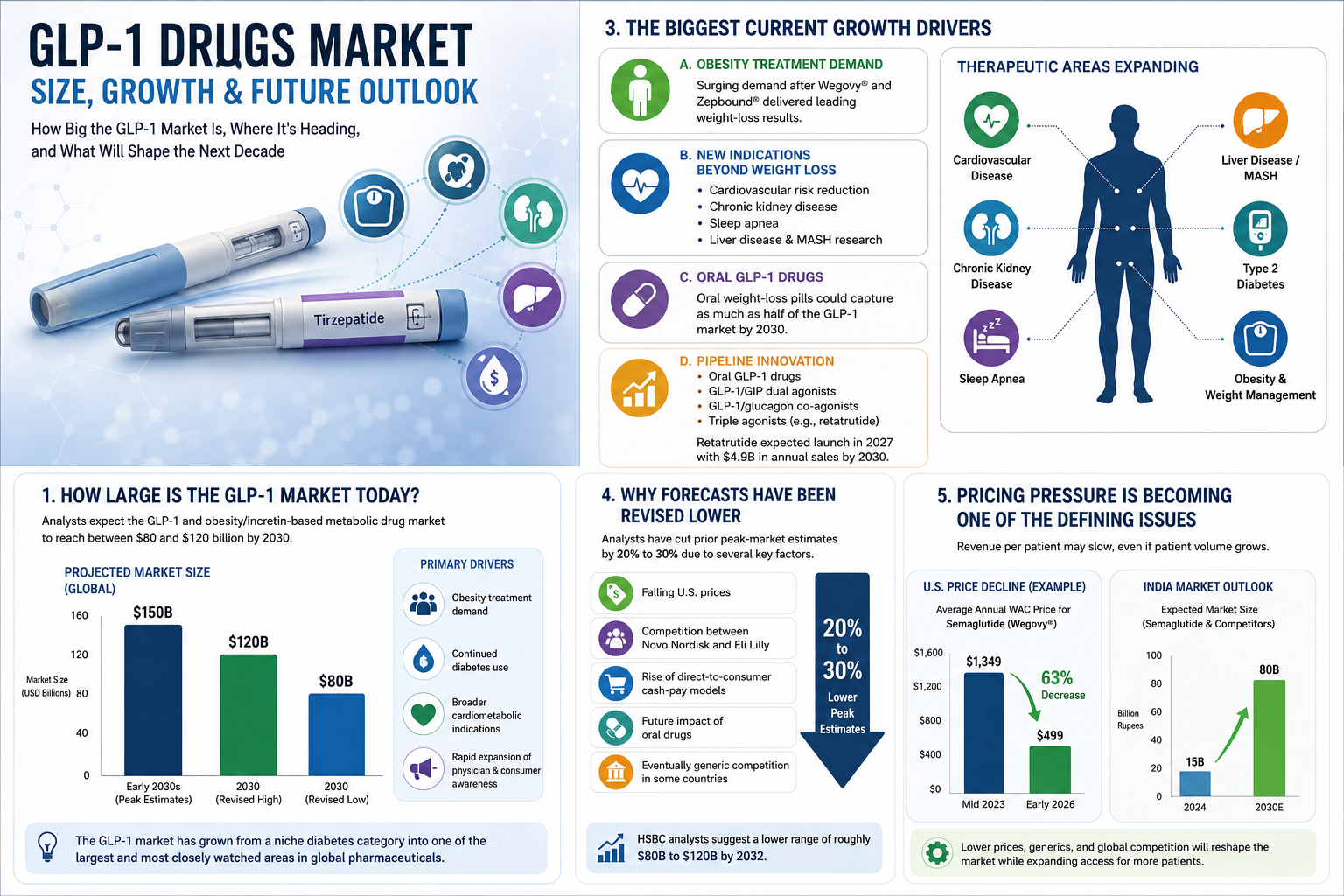
Under any of those definitions, the commercial scale of this drug class is extraordinary. Analysts cited by Reuters estimated the obesity-drug market at peak projections approaching $150 billion annually by the early 2030s. Those projections have since been revised downward materially, with more recent consensus clustering in the $80 billion to $120 billion range by 2030, depending on pricing, competitive dynamics, and the pace of oral drug adoption. The downward revision reflects greater sobriety about how quickly prices will fall and how aggressively payers will resist the cost of treating large patient populations with branded medications. What has not been revised is the conclusion that the market will be very large — the debate is about the ceiling, not the floor.(Reuters)
Analyst consensus for the GLP-1 and obesity-drug market has been revised from earlier peak projections of ~$150 billion annually to a more likely range of $80–$120 billion by 2030–2032, reflecting pricing pressure and competitive dynamics. The market remains on track to become one of the largest in pharmaceutical history.
Why the Market Grew So Fast
The pace of GLP-1 market expansion was not primarily driven by marketing or physician habit — it was driven by genuinely exceptional clinical results in conditions that affect enormous patient populations. Understanding what propelled the growth is important for evaluating its durability.
Three converging factors explain the speed of GLP-1 market expansion:
1. A New Standard of Efficacy in Obesity Treatment
For decades, pharmacologic weight-loss treatment was limited by modest efficacy — average weight reductions of 5 to 10 percent that left most patients far short of clinically meaningful improvement. Semaglutide at the Wegovy dose and tirzepatide at its Zepbound dose changed that calculus decisively, producing average weight losses of 15 to 22 percent — outcomes that approached those previously achievable only through bariatric surgery. That efficacy shift changed both physician prescribing behavior and patient demand simultaneously, creating a surge that existing supply chains were not built to accommodate.(IQVIA)
2. A Patient Population of Extraordinary Scale
Obesity and overweight affect a substantial proportion of the adult population in most developed markets and are increasingly prevalent in middle-income countries as well. The pool of patients who are both clinically appropriate for and interested in GLP-1 therapy is genuinely very large, and even modest penetration into that population generates revenue at a scale that no specialist drug ever could. Analysts have projected the potential oral obesity-drug market as particularly expansive, noting that pill formats eliminate injection barriers that currently prevent some patients from starting or continuing injectable therapy.(Reuters)
3. Expanding Indications Beyond Diabetes and Obesity
The clinical value of GLP-1 drugs is not confined to blood sugar control and weight loss. Semaglutide received approval for cardiovascular risk reduction in patients with established heart disease and obesity. Semaglutide’s 2024 approval for chronic kidney disease — based on the FLOW trial — extended the class into a new patient population with significant unmet need. Clinical data on obstructive sleep apnea, heart failure, and metabolic-associated steatohepatitis continues to accumulate. Each new approved indication expands the addressable patient population and provides prescribers with additional clinical justification for initiating therapy. Together, these indications transform GLP-1 drugs from a diabetes-and-obesity category into a comprehensive cardiometabolic therapeutic platform.(IQVIA)
Why Market Forecasts Have Been Revised Downward
The recalibration of GLP-1 market projections reflects a more realistic assessment of the commercial environment that is now emerging, rather than any fundamental doubt about the drugs’ clinical value or long-term importance. Reuters reported in February 2026 that some analysts had reduced their peak market estimates by 20 to 30 percent, citing a combination of factors that are reshaping the revenue outlook without necessarily reducing the volume of patients treated.(Reuters)
Pricing Competition Between Novo Nordisk and Eli Lilly
The GLP-1 market is currently a duopoly, with Novo Nordisk’s semaglutide products and Eli Lilly’s tirzepatide products competing directly in both the diabetes and obesity categories. Duopoly competition, while more moderate than a fully generic market, nonetheless produces pricing pressure — particularly as both companies seek to expand formulary coverage and negotiate with payers who have leverage over which drugs are preferred. The direct-to-consumer cash-pay channels that both companies have introduced, intended to reach uninsured or underinsured patients at below-list prices, have created additional pricing transparency that makes it harder to sustain premium revenue per prescription.
Oral Drug Development and Its Implications
The anticipated arrival of oral GLP-1 drugs — including Eli Lilly’s orforglipron, which is advancing through regulatory review — is expected to reshape the competitive landscape in ways that affect per-prescription revenue even as it potentially expands the treated population. Oral drugs are structurally easier and cheaper to manufacture and distribute than injectable biologics, and they may eventually support a more price-competitive market than the current injectable-dominated landscape allows. Structure Therapeutics has projected that oral weight-loss drugs could capture 25 to 50 percent of the GLP-1 obesity market by 2030, a shift with significant implications for how revenue is distributed across the category.(Reuters)
International Generic Competition
Outside the United States and Europe, the GLP-1 market is already entering a phase of generic and lower-cost branded competition. India approved generic semaglutide products in 2025, and Reuters reported in March 2026 that India’s drug regulator moved to tighten surveillance around unauthorized sales and misleading promotion as competition expanded rapidly. Analysts cited in that report projected the Indian GLP-1 market to grow from 15 billion rupees to approximately 80 billion rupees by 2030 — a trajectory that illustrates how generic entry can dramatically expand volume while compressing per-prescription revenue. The global market may therefore continue growing in patient numbers even as revenue-per-patient declines in markets where lower-cost competition has arrived.(Reuters)
Pricing Pressure as a Defining Market Variable
If any single factor is most responsible for the gap between earlier projections and the revised consensus, it is pricing. GLP-1 drugs currently command list prices that are among the highest for any widely prescribed chronic medication in the United States — generating extraordinary revenue per prescription but creating systemic access barriers that limit the size of the paying patient population and attract sustained political and payer attention.
The tension between high list prices, insurer resistance to formulary coverage, and patient inability to sustain out-of-pocket costs has produced an unusual market structure: high demand with constrained commercial throughput. Payers have broadly resisted covering GLP-1 drugs for weight management in the absence of cardiovascular or other qualifying comorbidities, and the Medicare program’s limitations on obesity drug coverage have excluded a substantial elderly population that might otherwise be clinically appropriate for treatment. HSBC analysts cited by MarketWatch argued that the most bullish projections for the obesity drug market are too optimistic and projected a more modest range of $80 billion to $120 billion by 2032 as a more defensible estimate.(MarketWatch)
The resolution of the pricing tension — through manufacturer discounts, payer formulary expansion, government coverage decisions, or eventual generic entry — will be the single most important determinant of how close to the upper or lower end of the projected range the market ultimately lands.
How Oral GLP-1 Drugs Could Reshape the Entire Market
The arrival of oral GLP-1 medications represents a potential structural inflection point for the market that goes beyond competition between individual products. Oral drugs matter for several reasons that compound each other: they eliminate injection barriers that currently prevent some patients from initiating or continuing therapy, they simplify prescribing in primary care settings where injectable medication management is less familiar, they improve convenience for patients who are otherwise good candidates for GLP-1 therapy, and they are manufacturable and distributable without the cold-chain and device infrastructure that injectable biologics require. IQVIA’s 2026 obesity market outlook identified oral obesity drugs as one of the defining trends shaping the category through the remainder of the decade.(IQVIA)
The critical question is whether oral GLP-1 drugs will primarily expand the treated population — by reaching patients who would not otherwise start injectable therapy — or primarily cannibalize the injectable market by converting existing injectable users to pills. If the former, the overall market grows; if the latter, revenue per patient may decline even as unit volume holds steady. The most likely outcome is some combination of both, with the net effect on total market revenue depending on how oral drugs are priced relative to their injectable counterparts. Eli Lilly’s orforglipron is the most advanced oral candidate and is expected to enter regulatory review in 2026. For a detailed analysis of what orforglipron’s profile means for patients and the market, see our orforglipron page.
The Pipeline Will Continue Expanding the Market
The GLP-1 drug market of 2030 will not look like the market of 2026 — not because the leading products will have lost their relevance, but because the pipeline of next-generation agents entering behind them will expand the category’s efficacy ceiling, its mechanistic diversity, and its addressable patient population. The key pipeline developments to watch are:
| Drug / Program | Status and Significance |
| Retatrutide (Eli Lilly) | Triple agonist targeting GLP-1, GIP, and glucagon receptors. Phase 2 data showed weight loss approaching 24% at 48 weeks. Analyst projections cited by Reuters anticipate a 2027 launch and $4.9 billion in annual sales by 2030. |
| Orforglipron (Eli Lilly) | Non-peptide oral GLP-1 agonist requiring no special administration conditions. Phase 3 data in diabetes and obesity populations. Regulatory submission anticipated 2026. |
| CagriSema (Novo Nordisk) | Fixed-dose combination of semaglutide and cagrilintide (amylin analogue). Phase 3 data pending. Designed to extend Novo Nordisk’s competitive position as tirzepatide raises the efficacy bar. |
| Amycretin (Novo Nordisk) | Combined GLP-1 and amylin receptor agonist. Earlier-stage development with promising initial signals. |
| VK2735 (Viking Therapeutics) | Dual GLP-1 and GIP agonist available in both injectable and oral formulations. Phase 2–3. Potential approval later this decade. |
Each of these programs, if it reaches approval, adds to a market that already contains multiple blockbuster products — not simply replacing existing drugs but expanding the category’s footprint by offering different efficacy profiles, delivery formats, or patient populations. The market’s future growth will be driven as much by the next generation of agents as by continued uptake of today’s leaders. For ongoing coverage of pipeline development, see our pipeline tracker page and our next-generation GLP-1 drugs page.
Geographic Dynamics: A Market That Will Look Different by Region
One of the most important structural features of the next decade’s GLP-1 market is that it will not be geographically uniform. The patent protection landscape, payer systems, regulatory approval timelines, and competitive dynamics differ significantly across markets, and those differences will produce meaningfully different outcomes depending on where patients live.
The broad regional picture that analysts expect to emerge through 2030 includes:
- United States and Europe: likely to remain premium branded markets for longer, given robust patent protection, established regulatory pathways, and health systems capable of absorbing high drug costs for appropriately qualified patients
- India and lower-cost markets: already experiencing generic entry following semaglutide patent expiration, with regulatory surveillance intensifying around unauthorized and misleadingly promoted products even as competition expands access at lower price points
- China and middle-income markets: increasingly important growth opportunities as local manufacturing capability expands and as both domestic and multinational companies compete for market share in high-population markets
- Global markets broadly: the expansion of oral GLP-1 options may be particularly impactful in markets where cold-chain logistics and device availability have constrained injectable uptake
The geographic divergence matters for the litigation landscape as well. The compounded GLP-1 market that developed in the United States during the shortage period — and has since been the subject of extensive FDA enforcement and civil litigation by Novo Nordisk and Eli Lilly — reflected a specifically American set of market conditions: high branded prices, inadequate insurance coverage, and a telehealth infrastructure capable of rapidly distributing lower-cost alternatives. For a full account of the compounded GLP-1 market and its legal consequences, see our compounded GLP-1 medications page.
Risks That Could Slow or Constrain Future Market Growth
The projected growth trajectory for GLP-1 drugs is compelling, but it is not guaranteed. Several risks could slow or constrain the market’s expansion, and they are worth examining with the same seriousness that analysts bring to the upside case.
Reimbursement and Affordability Constraints
The single largest near-term constraint on market growth is not clinical — it is financial. High list prices combined with variable and often limited insurance coverage mean that a substantial proportion of patients who could benefit from GLP-1 therapy either cannot afford to start it or cannot sustain it long enough to achieve durable benefit. GLP-1 drugs are maintenance medications: their metabolic benefits largely persist only with continued use, and patients who discontinue therapy — whether because of side effects or cost — typically regain weight. If coverage does not expand materially, the effective patient population will remain constrained well below the theoretical addressable market.
Gastrointestinal Side Effects and Discontinuation Rates
Real-world persistence on GLP-1 therapy is meaningfully lower than the retention rates observed in tightly managed clinical trials. Gastrointestinal side effects — including nausea, vomiting, and in a subset of patients the more serious complications of gastroparesis and bowel obstruction that are at issue in the current litigation — are a significant driver of discontinuation. Lower-than-expected persistence reduces both individual patient benefit and aggregate market revenue. If next-generation drugs or oral formulations can improve tolerability alongside efficacy, persistence may improve; if they cannot, this constraint will persist.
The safety profile of GLP-1 drugs and its evolution through post-market surveillance is covered in detail on our severe adverse reactions page and our benefits vs. risks page.
Political and Regulatory Scrutiny
GLP-1 drugs generate billions of dollars in annual revenue at list prices that are difficult to justify on manufacturing cost grounds, and they are prescribed in conditions that affect very large populations. That combination makes them prominent targets in pharmaceutical pricing debates. Regulatory actions — including direct government negotiation under the Inflation Reduction Act’s Medicare drug pricing provisions and international reference pricing — could materially reduce per-prescription revenue in ways that affect manufacturer investment in next-generation development. Litigation, including the ongoing GLP-1 MDL proceedings, represents a separate dimension of regulatory and financial risk for the leading manufacturers.
Competitive Intensity From New Entrants
The GLP-1 market is no longer a Novo Nordisk and Eli Lilly duopoly at the clinical development level. Multiple companies — including Structure Therapeutics, Viking Therapeutics, Pfizer (which has discontinued two oral candidates but has not exited the space entirely), and others — are developing GLP-1 and incretin-based drugs that could enter the market later this decade. As the competitive field expands, pricing pressure intensifies and no single company’s market position is secure. Reuters reported that the anticipated arrival of oral drugs is expected to be one of the most disruptive competitive dynamics the branded injectable market has yet faced.(Reuters)
Market Outlook Through 2030 and Beyond
The most defensible summary of where the GLP-1 and obesity-drug market is heading over the next five to ten years is this: the market will be very large, but the distribution of that revenue — across products, geographies, and price levels — will be considerably more complex and competitive than the earlier narrative of unconstrained blockbuster growth suggested.
IQVIA’s broader 2026 global medicine use forecast provides a supportive macro backdrop: global medicine use is projected to continue growing through 2030, with metabolic disease categories among the primary drivers. The GLP-1 class is well-positioned to benefit from that macro trend while also navigating the market-specific dynamics discussed above.(IQVIA)
The questions that will most determine the market’s trajectory are not about clinical efficacy — GLP-1 drugs have demonstrated their value across multiple endpoints — but about the commercial and structural environment in which that value is delivered:
- How quickly will oral GLP-1 drugs reach the market, at what price points, and will they expand the treated population or primarily convert existing injectable users?
- How will payer and government decisions on coverage and pricing evolve, particularly in the United States where Medicare coverage for obesity treatment remains limited?
- Which next-generation agents — retatrutide, CagriSema, orforglipron, VK2735 — will reach approval and achieve meaningful commercial scale?
- How will the geographic market split evolve as generic competition arrives earlier in some markets than others?
- How will the ongoing litigation in MDL 3094 and MDL 3163 affect manufacturer reputation, label requirements, and the cost of litigation reserves that affect financial projections?
The answer to those questions will determine whether the market lands at the lower or upper end of the current $80–$120 billion consensus range — and whether it ultimately proves even larger than the current revised projections suggest, as oral drugs and new indications expand the addressable patient population in ways that today’s models may underestimate.
Related Resources
Explore the main resource, related topics, and additional cross-references.
- Main resource: GLP-1 Drugs
- Related topic: GLP-1 Drugs and Muscle Loss
- Related topic: GLP-1 Mental Health Effects, Mood, Cravings & Behavior
- Also review: GLP-1 Drug Lawsuits (2026)